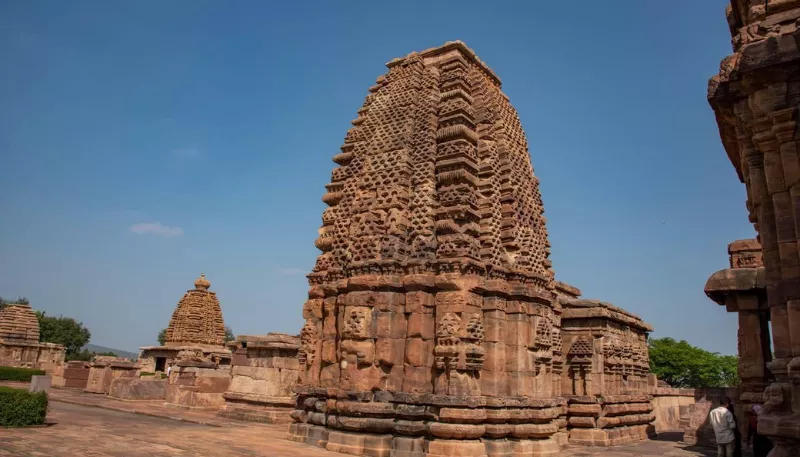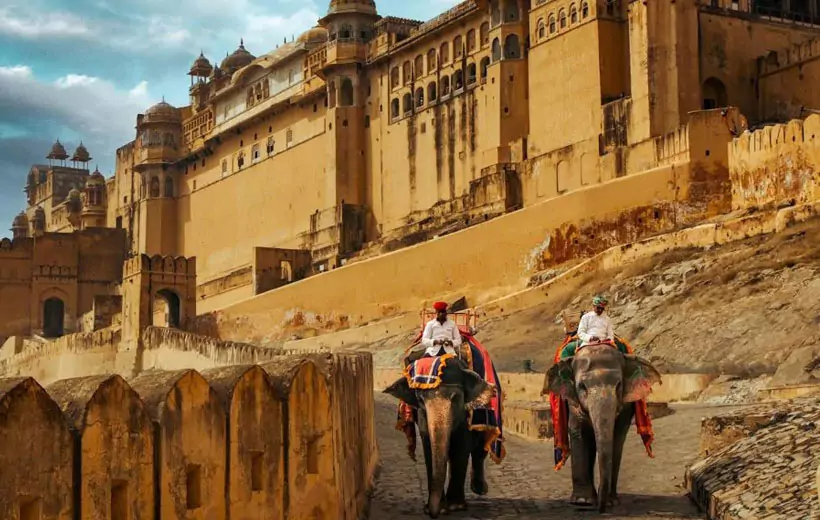

This 2-day Varanasi trip gives you a full, well-paced introduction to India’s holiest city. The first day focuses on the heart of old Varanasi — the Kashi Vishwanath Temple, the surrounding sacred sites and the famous evening Ganga Aarti at Dashashwamedh Ghat, watched from the river by boat. The second day takes you through the southern temple circuit near Durgakund, the beautiful Banaras Hindu University campus and the extraordinary Buddhist site at Sarnath.
The itinerary is built for travelers who want to experience Varanasi properly — not rush through it. Every stop is chosen carefully. Every timing is practical. You get the full picture of a city that has been calling travelers, pilgrims and seekers to its banks for thousands of years.
Tour Highlights
Accommodation & Customisation
Our 2 Day Varanasi Tour package includes a comfortable stay in a carefully selected, well-rated 3-star hotel in Varanasi, offering a relaxing environment after your spiritual and cultural exploration. All accommodations are equipped with essential modern amenities and include daily breakfast for a smooth travel experience. For travellers who prefer a more luxurious stay, we provide the option to upgrade to 4-star or 5-star hotels. This short Varanasi getaway can be fully customised according to your comfort level, travel style, and budget.
Your 3-Star Hotels Included:
Hotels are confirmed at the time of booking based on availability. In case of unavailability, an equivalent or higher-category hotel will be provided.
Morning — Arrival and Old City Temple Circuit
Arrive in Varanasi and check in to your hotel. Once you have freshened up, the day begins.
Your first stop is Kal Bhairav Temple. There is a custom in Varanasi that every visitor must first seek permission from Baba Kal Bhairav — the fierce guardian deity of the city — before beginning their pilgrimage here. The temple sits in a busy lane of the old city. The main deity is a powerful form of Lord Shiva. The experience of visiting is unlike most temples you have been to — active, intense and deeply traditional.
From Kal Bhairav, make your way through the lanes of the old city toward the Kashi Vishwanath Temple.
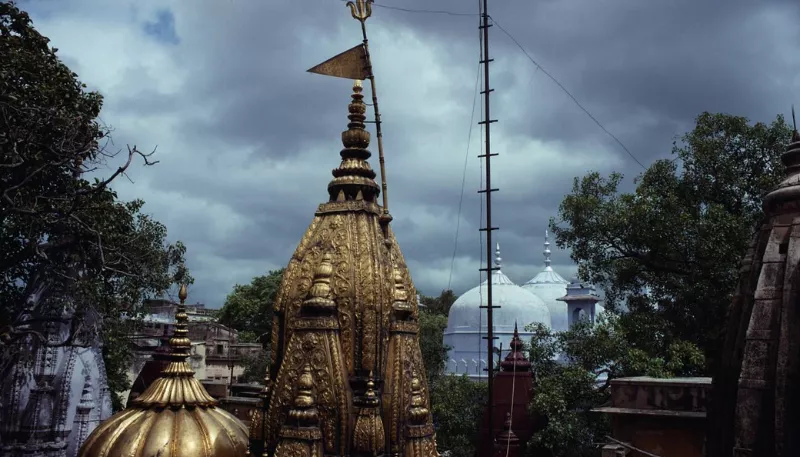
This is one of the twelve Jyotirlinga temples in India — the most important Shiva temples in the country — and it is widely regarded as the holiest of them all. The original temple was destroyed multiple times over the centuries and rebuilt each time. The current structure was built in 1780 by Maharani Ahilyabai Holkar of Indore. The golden spires were donated by Maharaja Ranjit Singh in 1835. Inside, the energy of the place — the constant chanting, the smell of flowers and sacred water, the press of devoted worshippers — is something you will not forget.
Right next door is the Maa Annapurna Temple, dedicated to the goddess of nourishment and food. It is considered one of the most important goddess temples in Varanasi and sits so close to the Vishwanath Temple that most pilgrims visit both in a single walk.
After the temple circuit, spend some time walking through the lanes around the complex. These narrow alleys — called galis — are packed with small shops, tea stalls and temples at every turn. It is easy to get wonderfully lost in them.
Afternoon — Rest Before the River
Return to your hotel for lunch. Rest for a while.
The evening is the heart of Day 1 and you want to be well-rested for it. The Ganga Aarti at Dashashwamedh Ghat begins around 6:00 PM in winter and 6:30 PM in summer. Your boat should be on the river at least 30 to 45 minutes before the ceremony starts.
Make sure your boat is arranged in advance — either through your hotel, your tour operator or a trusted local boatman at the ghat. Prices vary but a shared boat is affordable and a private boat gives you more space and flexibility.
Evening — Boat Ride and Ganga Aarti
This is the experience that most people say stays with them longest from their entire time in India.
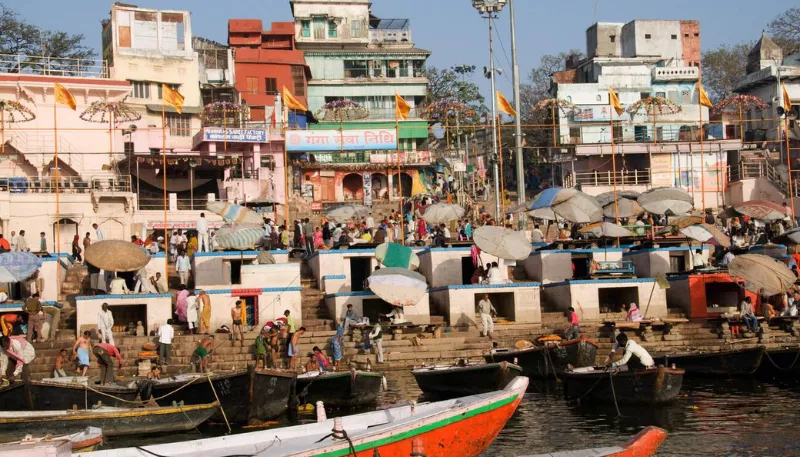
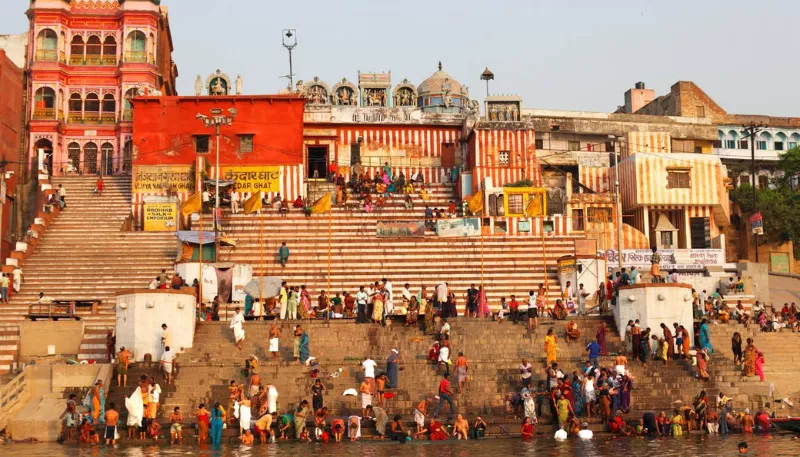
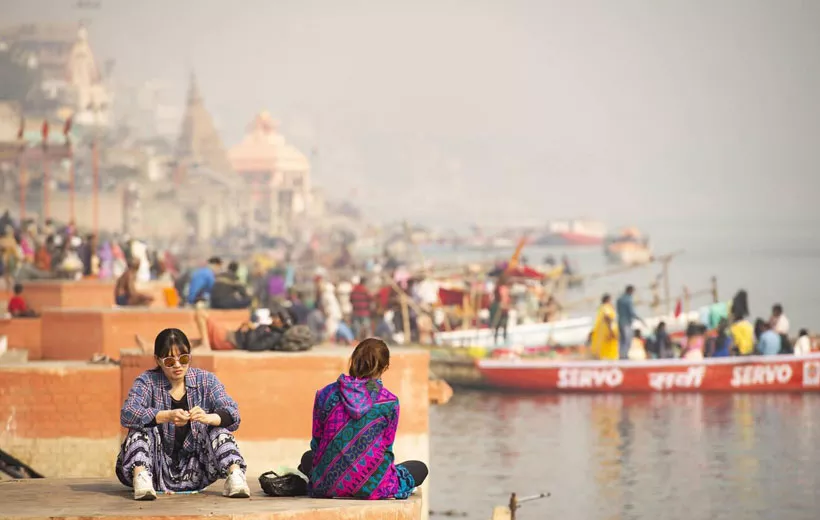
Board your boat in the late afternoon, around 5:00 to 5:30 PM. As you push off from the ghat, the city opens up in a way that you simply cannot see from the steps. The full sweep of Varanasi’s 84 ghats stretches out along the western bank of the river — stone staircases, ancient temples, domed structures, coloured umbrellas, rows of boats and the constant motion of people bathing, praying and washing.
Your boatman rows slowly south to north. You pass:
Assi Ghat- the southernmost major ghat, popular with morning bathers and yoga practitioners
Kedar Ghat – one of the oldest ghats in Varanasi, with a red-striped temple at its top
Harishchandra Ghat – one of the two main cremation ghats
Dashashwamedh Ghat – the most famous and most visited ghat in Varanasi
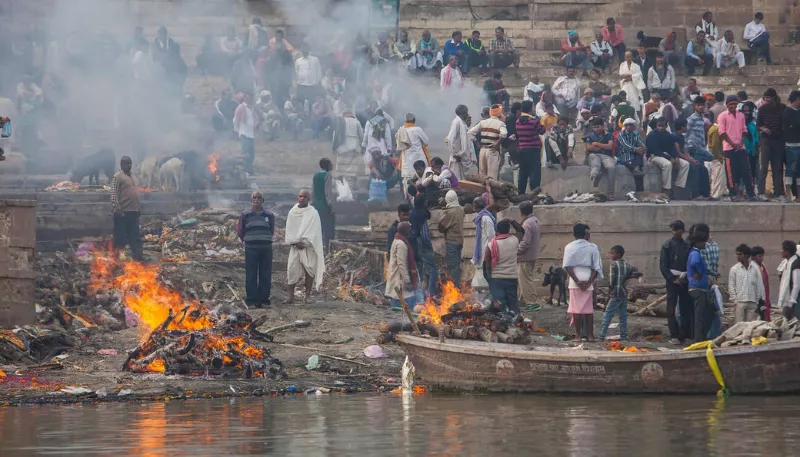
Manikarnika Ghat – the main cremation ghat where pyres burn continuously, 24 hours a day, 365 days a year
Manikarnika is a confronting place to witness. The smoke rises in thin columns above the ghat. The fire never goes out. Hindus believe that dying in Varanasi and being cremated at Manikarnika grants moksha – liberation from the cycle of birth and death. Families come from across India to bring their loved ones here. Watching from the boat, with respect and silence, is appropriate and meaningful.
As darkness falls, the Ganga Aarti at Dashashwamedh Ghat begins.
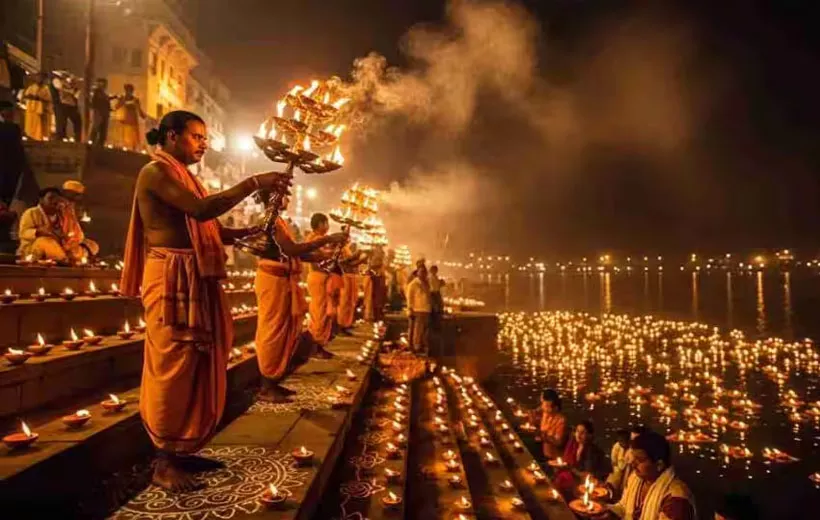
Seven priests stand in a line on the ghat steps, each holding a large multi-tiered brass lamp. They move in perfect synchrony — raising the lamps toward the sky, toward the river, in slow sweeping circles — while Sanskrit chants rise above the crowd, temple bells ring continuously and incense smoke fills the air. Hundreds of small earthen lamps float out onto the river. The ceremony lasts around 45 minutes.
Watching it from the boat, with the reflection of the lamps dancing on the water below you, is one of the most extraordinary things this country has to offer.
After the aarti, walk through Vishwanath Gali — the narrow lane near the temple famous for Banarasi silk sarees, silver jewelry, religious items and handicrafts. Have dinner at a good local restaurant and try Varanasi’s famous street food. Tamatar chaat, rabri jalebi and Banarasi paan are all worth tasting before you sleep.
Overnight in Varanasi.
Early Morning — Sunrise Aarti (Optional)
If you are an early riser, go to Assi Ghat by 5:30 AM in winter or 6:00 AM in summer for the morning aarti — called Subah-e-Banaras. It is quieter and more intimate than the evening ceremony at Dashashwamedh. The mist sits on the river in the early morning. The light comes in slowly. Boatmen row past in silence. It is a very different Varanasi from the busy one you experienced yesterday evening.
Morning — Durgakund Temple Circuit
After breakfast or the sunrise aarti, head to the southern part of the city for the morning temple visits.
First Stop — Durga Mata Mandir (Durgakund Temple)
This is one of the most recognizable temples in Varanasi — a striking red-painted structure built beside a large square tank called Durgakund. The temple was constructed in the 18th century and is dedicated to Goddess Durga in her fierce form. Monkeys are everywhere around the complex — they are considered sacred here and are completely used to visitors. The temple is busy every morning with devotees offering flowers, vermilion and coconut.
Second Stop — Tulsi Manas Mandir
Right next to the Durga temple stands the Tulsi Manas Mandir — a white marble temple built in 1964 at the very spot where the great poet-saint Tulsidas is believed to have written the Ramcharitmanas, the most widely read Hindi version of the Ramayana. The walls of the temple are inscribed with verses from this sacred text. The atmosphere inside is calm and devotional — a good contrast to the energy of Durgakund next door.
Third Stop — Sankatmochan Hanuman Temple
A short auto-rickshaw ride from Durgakund brings you to the Sankatmochan Hanuman Temple — arguably the most loved temple in all of Varanasi. It was established by the saint Tulsidas himself and is dedicated to Lord Hanuman. The name Sankatmochan means “the one who removes difficulties,” and devotees come here in large numbers every day. Monkeys live freely within the temple compound and are considered sacred. In the evenings, the temple hosts classical music performances attended by serious musicians and devotees alike.
Mid-Morning — Banarasi Street Breakfast
After the morning temples, stop for a proper Banarasi breakfast on the street.
The classic combination is Kachori Sabzi — deep-fried spiced flatbread served with a thick, spicy potato curry — followed by hot Jalebi dipped in sugar syrup. You will find excellent versions of this around Godowlia, the Durgakund area and the lanes near Sankatmochan Temple. It is inexpensive, deeply satisfying and completely Banarasi.
Before moving on, pick up a Banarasi Paan from a local paan stall. The paan-wallahs of Varanasi have been perfecting their recipes for generations. Even if you have had paan elsewhere, the Banarasi version is genuinely different.
Late Morning — Banaras Hindu University
Drive to the Banaras Hindu University (BHU) campus in the southern part of the city.
BHU is one of the largest residential universities in Asia — spread across more than 1,300 acres with schools of arts, science, engineering, medicine, law and fine arts all on the same campus. The green, tree-lined avenues and colonial-era buildings make it a pleasant place to walk through.
Inside the campus, the main attraction is the New Kashi Vishwanath Temple, also known as the Birla Temple (VT BHU). This white marble temple was built by the Birla family and is modelled on the original Kashi Vishwanath Temple in the old city. It is open to visitors of all faiths — something the original temple is not always — making it accessible to every traveler.
The Bharat Kala Bhavan Museum on the campus houses an exceptional collection of miniature paintings, sculptures, manuscripts and textiles from different periods of Varanasi’s long history. It is worth an hour of your time if it is open. Note that the museum may be closed on public holidays.
Afternoon — Sarnath
After lunch, drive to Sarnath — about 10 to 11 kilometres from the city, roughly 20 to 30 minutes by road.
Sarnath is one of the four holiest sites in Buddhism. This is the place where Siddhartha Gautama — the Buddha — came after attaining enlightenment at Bodh Gaya and delivered his very first sermon to his five former disciples. That first teaching set in motion the entire tradition of Buddhism. Sarnath is where it all began.
The site today is peaceful, well-maintained and genuinely moving — both for Buddhists and non-Buddhists alike.
Evening — Final Hours in Varanasi
Return to Varanasi in the late afternoon. If your departure schedule allows, spend the final evening at Assi Ghat — calmer and more local than Dashashwamedh, with a good atmosphere in the evenings.
Departure the next morning as per your travel schedule.
Yes. Two days cover the most important and meaningful experiences the city offers — the sacred temples of the old city, the evening Ganga Aarti by boat, the southern temple circuit and Sarnath. You will not see everything — that would take weeks — but you will leave with a complete and genuine picture of Varanasi.
October to February is ideal. The weather is comfortable, the ghats are active and the festivals during this period — including Dev Deepawali in November — are extraordinary. Avoid May and June when temperatures cross 45°C regularly. July to September is monsoon season with heavy rainfall.
The Ganga Aarti at Dashashwamedh Ghat starts at approximately 6:00 PM in winter and 6:30 PM in summer. The ceremony lasts about 45 minutes. Be on the river by boat at least 30 minutes before it begins.
Yes, you can visit from the boat or by walking along the ghat. However, never photograph the cremations — it is disrespectful and prohibited. Keep a respectful distance and observe in silence.
Yes, Varanasi is generally safe. Stick to well-known ghats and lanes during the day. At night, use a trusted auto-rickshaw or cab and avoid isolated alleys in the old city. Trust your instincts and keep your valuables secure.
Kachori Sabzi — the essential Banarasi breakfast | Jalebi — hot, crispy and fresh | Tamatar Chaat — spicy and unique to Varanasi | Rabri Jalebi — sweet and indulgent | Banarasi Paan — the famous betel leaf preparation
Sarnath is approximately 10 to 11 kilometres from Varanasi city centre. The drive takes about 20 to 30 minutes by road. It fits comfortably into Day 2 as an afternoon visit and needs around 2 to 3 hours to see properly.
Yes, we require a 30% to 50% secure advance payment via UPI, bank transfer, or IMPS to confirm your booking, with the remaining balance payable at 25% payment on arrival and 25% payment before the end.
You can cancel free of charge up to 15 days before arrival. Cancellations made 7 days before arrival will incur a 50% charge, and cancellations within 48 hours of the tour start date are non-refundable.
We are here to help you with any inquiries regarding our services. Whether you need more details about our tour packages, want to book a trip, or have specific travel requirements, feel free to reach out to us.
Email: info@privatedriverindiatour.com
Phone: +91-9810368671
24/7 Our team is available to assist you. We look forward to helping you plan your perfect journey!
Private Driver India Tour, founded in 2006 by Mr. Amit Singh, is dedicated to providing unforgettable travel experiences in North India, led by professional drivers with years of expertise serving global travelers.
More About Us© Private Driver India Tour 2024-26 | All rights reserved.