




A private car is most useful when it solves a practical problem. That might be carrying airport luggage, keeping a family together or connecting several places that are not easy to visit in one continuous walk.
For first-time visitors, the main advantage is continuity. You know which vehicle you are returning to and can discuss the next stop without starting a new transport arrangement.
The same flexibility helps when plans change. A museum may take longer than expected, someone may need a rest, or the weather may make another outdoor visit less appealing.
Rather than treating the itinerary as a fixed list, you can decide what still feels worthwhile. Within the agreed booking, your driver can help adjust the sequence.
However, a car is not the answer to every journey. A short walk between nearby places may be more enjoyable, while the Metro can be useful when stations suit your route. Good planning uses each option for what it does well.
Delhi becomes easier to plan when you stop looking at attractions as separate names and start thinking about areas. Repeatedly crossing the city is one of the quickest ways to lose sightseeing time.

Old Delhi includes the area around Jama Masjid, Chandni Chowk and the Red Fort. Its character comes from the streets and everyday activity as much as from individual monuments.
A driver can help you approach the area, but you should expect to leave the vehicle for part of the visit. Narrow lanes and access arrangements may make walking or a rickshaw more practical.
Ask where you will be dropped, how the local section works and where the driver will collect you afterwards.
The India Gate area, Connaught Place and selected central landmarks can work as a combination of driving and walking.
Be clear about what the itinerary includes. Driving past a building is different from stopping for photographs, and both are different from an interior visit.
Humayun’s Tomb, Lodhi Garden and Qutub Minar are familiar choices, but they do not all sit beside one another.
Choose the order according to your hotel, traffic and the time you want inside each place. Avoid assuming that a quick drive between names on a map means an effortless sightseeing sequence.
Akshardham deserves a dedicated time window if it matters to you. Entry arrangements, security and your chosen activities can make a rushed visit frustrating.
It is better to replace another stop than add it to an already crowded schedule.
Not every car booking gives you the same freedom. A direct airport transfer normally covers one agreed journey. A sightseeing package provides a service window with specified conditions.
An outstation trip, such as Delhi to Agra, is another type of booking. Do not assume a local Delhi package automatically includes travel beyond the agreed area.
| Service | Best Used For | Check Before Booking |
|---|---|---|
| Airport transfer | Airport to hotel or hotel to airport | Terminal, waiting allowance and luggage |
| Half-day car hire | A few visits within a limited area | Hours, kilometres and return point |
| Full-day sightseeing | Several planned stops with a meal break | Route, overtime, parking and guide services |
| Outstation journey | Trips beyond the local sightseeing area | Road charges, distance, return and driver arrangements |
A clear airport pickup begins before you fly. Send the operator your flight number, arrival date, full hotel address, passenger numbers and luggage details.
Ask whether someone meets you with a name sign or whether you need to proceed to a designated pickup area. Different services and terminals may use different arrangements.
Delhi Airport provides information on prepaid, app-based and other taxi services. Follow the instructions for your actual booking rather than assuming every vehicle waits immediately outside arrivals.
Flight landing time is not the same as the time you will reach the meeting point. Immigration, baggage collection and the walk through the terminal all need allowance.
Ask how delays are handled and when additional waiting charges begin. Keep the meeting instructions and contact details available offline in case your phone does not connect immediately.
If your flight arrives shortly after midnight, double-check the calendar date. It is an easy detail to overlook when planning from another time zone.
That depends on your flight, rest and available time. Some travellers feel ready for a short outing; others need a quiet meal and sleep.
Avoid making your entire arrival day depend on several prepaid activities. A delayed flight or slow airport exit could make the schedule uncomfortable.
Also confirm hotel check-in. Arriving in the morning does not necessarily mean your room is available, unless early access has been arranged.
A sensible arrival-day plan might include a hotel transfer, a break and one optional nearby visit. Keep it easy to shorten.
The first day should help you settle into Delhi, not leave you exhausted before the main sightseeing begins.
Arrive with a Plan
Share your flight details, hotel location and travel preferences.
Ask about an airport transfer or a gentle arrival-day plan
with a suitable private vehicle.
One day gives you an introduction. Two days make it easier to separate areas and enjoy the places instead of constantly moving between them.
A third day is valuable if you enjoy museums, shopping, neighbourhood walks or a cooking experience. It can also provide flexibility around opening arrangements and weather.
Do not decide only by counting attractions. Think about the depth of each visit. A photograph outside a monument might take a short time, while an interior visit with a guide needs much more.
If Delhi is part of a longer itinerary, compare how much sightseeing is already included before booking extra car days.
For example, our Golden Triangle tour with Udaipur includes Delhi within a wider journey. Review the complete schedule before adding a separate city tour that could repeat the same places.
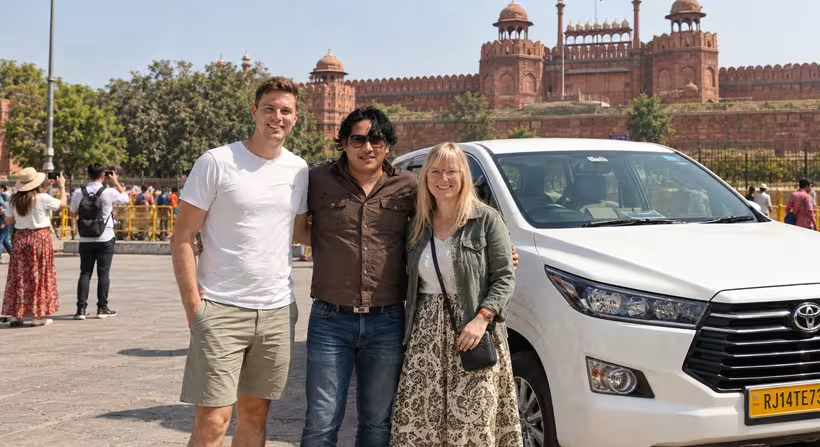
A successful one-day visit needs priorities. Choose a few substantial experiences and leave room for lunch, walking and traffic.
The route below is an example. Your hotel location and current conditions may make a different order more sensible.
Explore the area around Jama Masjid and Chandni Chowk with a clear plan for the walking section. A local guide can help explain the surroundings if you want more than transport.
Decide whether the Red Fort is an interior visit or an outside view. Trying to fit both a detailed fort visit and a long market walk into a short morning may push everything else back.
Plan a meal before everyone becomes tired. Explain your preferences, budget and dietary requirements rather than waiting until you are hungry to start discussing them.
A quieter lunch may be more useful than another famous location if the morning has been busy.
Humayun’s Tomb can provide a different atmosphere after Old Delhi. Allow enough time for the visit rather than treating it as another ten-minute stop.
If Qutub Minar is your priority instead, adjust the route around it. You do not need to include every famous monument to have a satisfying day.
Depending on traffic, add the India Gate area or Connaught Place. Alternatively, return to your hotel and enjoy the evening independently.
A calm finish often leaves a better impression than rushing towards one final attraction with little time left.
With two days, give each day a distinct character. This reduces unnecessary travel and makes the visits feel less repetitive.
Start with the old-city area, choosing between a longer monument visit and more time in the market streets. Follow with lunch and selected central stops. Keep the afternoon flexible. You may find that one unexpectedly interesting place deserves more time than your original plan allowed.
Choose Humayun’s Tomb and Qutub Minar in a practical order, then add a garden, museum or other stop that matches your interests.
If you prefer religious architecture, consider an appropriate temple visit instead of another monument. If you enjoy shopping, give it a proper time window rather than squeezing it between timed activities.
Akshardham can also shape a separate part of the day, subject to its current visitor arrangements. Avoid adding it casually after an already full programme.

Delhi does not need to look the same for every visitor. A family with young children may want fewer interior visits than an architecture enthusiast travelling alone.
If you enjoy history, allow longer inside one or two monuments and consider a professional guide. If you prefer everyday life, spend more time walking through selected neighbourhoods.
For photography, discuss the kind of images you want: architecture, gardens, streets or evening scenes. A route designed around photography may need different timing from a standard sightseeing day.
If you are interested in worship traditions beyond Delhi, our Golden Triangle tour with Mathura and Vrindavan offers one possible extension. Treat it as a separate multi-day journey, not a quick addition to a Delhi afternoon.
A private car can bring you towards Old Delhi, but it should not be presented as a way to avoid every walk.
Street width, crowds and local restrictions may prevent direct access to the places you want to see. The driver may need to wait in a designated area.
Ask how much walking is expected, whether a rickshaw is included and how the meeting point works at the end. Confirm local transport costs before starting.
For visitors with limited mobility, these details should be discussed before payment. A shorter, carefully chosen visit can be better than a long route that becomes uncomfortable.
Be respectful around shops, homes and places of worship. People are going about their lives, and not every lane is a suitable place for a group to stop for photographs.
There is no single citywide price for every private car service. The total depends on your vehicle, pickup point, duration, route and included services.
A transport-only booking differs from a guided sightseeing package. Airport transfers, tickets, meals and local activities may be separate.
Compare quotations for the same request. If one operator includes parking and another excludes it, the headline amounts are not directly comparable.
Delhi Tourism’s published packages show that additional kilometres, extra hours and parking can have separate conditions. Private operators may structure their bookings differently, so read the actual terms.
A package with an eight-hour and 80-kilometre allowance usually has two limits. Ask what happens when you exceed either one.
Also confirm where the calculation begins. Some services count from your hotel pickup; others may calculate from the vehicle’s starting location.
Ask whether traffic time counts within the booking window and how a delayed finish is charged. A clear answer is more useful than a vague promise of a “full day.”
Suppose your agreed car booking costs ₹4,000 before tickets, meals and parking. Using an illustrative exchange rate of ₹89 to US$1, that is approximately US$45.
For two people sharing, the transport contribution would be ₹2,000 each. For four people, it would be ₹1,000 each, provided the selected vehicle fits everyone comfortably.
This is only an example showing how to divide a quotation. It is not a market tariff or a confirmed offer. Ask for the actual price for your travel date.
| Item | What to Ask |
|---|---|
| Vehicle and driver | Which model or category is confirmed? |
| Fuel and distance | Is fuel included, and what is the kilometre allowance? |
| Parking and road charges | Are they included or payable separately? |
| Guide services | Is a separate sightseeing guide included? |
| Attraction tickets | Which entries, if any, are covered? |
| Extra time | What is the additional hourly charge? |
| Airport waiting | How much waiting is included after arrival? |
Mention the full pickup address if you are staying in Gurugram, Noida or another location outside the operator’s standard service area. Do not assume every quotation uses the same boundary.
A sedan may suit one or two people with modest luggage. For a sightseeing day after hotel check-in, you may need only space for small bags.
If airport transfers are included, tell the operator about your full luggage rather than assuming it will fit.
A larger vehicle can suit families or travellers who want more space. Ask about the actual model, seating layout and luggage capacity.
The advertised passenger count does not tell you how much room remains for suitcases when every seat is occupied.
A group vehicle can keep everyone together and simplify departures. Check the air conditioning, seat belts, luggage storage and ease of boarding.
Also ask how close it can reach your hotel. A narrow lane may require a different pickup arrangement from a broad hotel driveway.
Choose comfort and suitability rather than simply the biggest vehicle. A higher step or tight luggage arrangement can matter more than the category name.
Make the Day Yours
Tell us where you are staying, which places interest you and
how much walking suits your group. Ask for a practical route
and vehicle recommendation.
Traffic should influence the route from the beginning, not appear as an afterthought. The most useful itinerary avoids unnecessary backtracking and leaves room around time-sensitive activities.
Commuting periods can be busy, but congestion does not follow one perfect schedule. Events, roadworks, weather and security arrangements can affect the day.
Ask your driver to review the sequence before departure. Changing the order may preserve the visits while reducing wasted road time.
For example, it may make sense to visit an attraction near your hotel first rather than crossing the city to follow a standard printed programme.
Avoid using a tight restaurant reservation or shopping appointment to squeeze in sightseeing. The more fixed commitments you add, the less flexible the day becomes.
Your driver may not be able to wait where you leave the vehicle. Parking rules and permitted waiting areas can require them to move.
Before entering an attraction, agree on the collection point and whether you should call when you are leaving. Some places have several exits, so confirm which one you will use.
Save the meeting point by message. A recognisable gate, landmark or approved pickup area is better than “outside the monument.”
Carry your phone and essential belongings. If the driver has parked elsewhere, returning to the car for something you forgot may take time.
Do not rely only on live messaging. A backup meeting instruction is useful if your phone battery fails or mobile data becomes unreliable.
A driver manages the agreed road journey. A guide explains the places you visit and may accompany you through monuments, streets and museums.
Some packages include both services, but a transport booking does not automatically include detailed guiding.
If your main interest is history, ask about a separate guide and the language available. Confirm whether the guide joins for the whole day or selected visits.
Also explain the English communication level you need from the driver. Basic travel conversation may be sufficient for some guests, while others need more detailed discussion.
Clear expectations are better than assuming one person will drive, interpret, explain every monument and manage all tickets at the same time.
Each can be useful. Choose according to the complete journey rather than deciding that one option must cover your entire holiday.
A dedicated vehicle suits several stops, agreed waiting arrangements and travellers who want a known vehicle throughout the day.
It can also help when the group needs extra luggage space or a clearly planned return to the hotel.
A point-to-point ride may suit dinner, a single attraction or a short journey where you do not need the vehicle to wait.
Follow the app’s pickup instructions, check the vehicle information and allow time for the driver to reach the meeting point.
The Metro can avoid road congestion during the rail portion of a trip. It is particularly useful when both ends are conveniently connected.
However, consider walking, security, transfers and luggage as well. The fastest train journey is not always the simplest door-to-door option.
There is no need to prove anything by using only one type of transport. A comfortable Delhi visit can combine a private sightseeing day with independent journeys at other times.
Delhi attractions do not all follow the same schedule. Some have weekly closures, while access to others may change for maintenance, events or security reasons.
Akshardham’s official visitor information lists a Monday closure and restrictions on phones and cameras. Check the current details before including it.
For other places, verify the latest information directly rather than relying on an old copied itinerary. Be especially cautious when different websites repeat conflicting opening-day claims.
If a must-see attraction is unavailable, adjust the day thoughtfully. Replacing it with one suitable experience is often better than adding several unrelated stops.
Ask the operator to review the route for your actual date, not just the general month of travel.
Allow time for entry checks and ticket arrangements. Having a car does not give you priority access or remove the need to follow site rules.
Ask whether you should purchase official tickets in advance and which identification, if any, is required for the chosen visits.
Carry a manageable bag. Some places restrict electronics, food, large bags or photography equipment, and rules vary between sites.
Do not assume the vehicle is a secure storage facility for valuables. Keep passports, money and essential items under your own control or use appropriate approved storage.
Avoid unofficial promises of guaranteed access or special treatment unless the exact service and legitimacy are clear.
Mosques, temples and other religious sites remain places of worship. Tourist visits should fit around their purpose and current access arrangements.
Wear suitable clothing and follow instructions about footwear, head coverings, photography and where visitors may enter.
Keep voices low where appropriate and avoid blocking people taking part in prayer. Ask before taking close photographs of individuals.
If a ritual or ceremony interests you, allow time to observe without treating it as a performance that must fit your schedule exactly.
Your driver may explain practical arrangements, but site staff and current notices should guide the actual visit.
A family-friendly day is not simply a normal itinerary completed more slowly. It may need fewer stops, shorter walks and more predictable meal breaks.
Tell the operator about child seats, strollers, walking limits and boarding difficulties before choosing a vehicle.
For older visitors, ask about steps, uneven surfaces, resting places and restroom access. A private car reduces transport coordination, but it cannot remove every physical challenge.
Keep an optional stop that can be dropped without disappointment. This gives you a way to respond when someone needs a rest.
A relaxed lunch or early hotel return is not a failure of the itinerary. It may be what allows everyone to enjoy the following day.
A private driver can simplify logistics, but keep your independence. Share your route with someone you trust and save an operator contact separate from the driver’s number.
You can decline shopping visits, request a public meeting point and ask for clarification when the plan changes.
Keep control of your documents, phone and money. Do not assume a fluent conversation or friendly manner is a substitute for checking the booking and vehicle.
If a stop or interaction makes you uncomfortable, say so and contact the operator where necessary. Clear boundaries help make the experience more predictable.
Food and shopping can add pleasure to the day, but they should not appear as unexpected obligations.
Tell your driver whether you want a quick meal, a longer lunch, vegetarian options or a particular budget. If you have a serious allergy, communicate directly with the restaurant and provide written information where needed.
If you do not want shopping visits, say so before departure. A simple message can prevent confusion: “We would like sightseeing only and will ask if we want to shop.”
When you do choose to shop, allow enough time and compare prices. Ask about materials, authenticity, shipping and return terms before an expensive purchase.
You are not required to buy anything because someone recommended a business.
In hot conditions, plan longer outdoor visits earlier where opening hours permit. Keep a proper break rather than assuming air conditioning makes an overloaded day comfortable.
Cooler mornings may require an extra layer, while rain can affect walking surfaces and the appeal of an outdoor market visit.
Check current air-quality information, particularly if you have respiratory concerns, and follow your clinician’s advice about appropriate precautions.
Keep the plan adjustable. Shortening an outdoor visit or choosing an earlier return can be sensible, not disappointing.
A useful itinerary works with the conditions you actually encounter instead of depending on ideal weather.
Avoid carrying items you will not use. A lighter bag is easier through security checks and during walks.
Before departure, check that you have everything you need rather than planning repeated returns to a parked vehicle.
A restaurant visit or evening outing can be enjoyable, but confirm the service hours. A driver who started early should not automatically be expected to continue late into the night.
Ask whether evening use requires extra time, a break or a separate transfer. Agree on the pickup location after dinner.
Keep the outing focused on one area rather than adding several distant stops. After a full sightseeing day, less driving may feel more rewarding.
For airport departures, leave a separate travel buffer. Do not build a final evening around reaching the terminal at the last possible moment.
If you have an additional full day, Agra can form a separate excursion. It should not be treated as a small extension of a Delhi city tour.
A return road journey requires an early start, sightseeing time, meals and a substantial driving commitment. Keep the day clear rather than adding Delhi appointments afterwards.
Our Delhi to Agra day trip by private car is one option to review. Confirm attraction access, pickup time, current inclusions and the expected return.
If you prefer rail travel for the main intercity section, compare the same-day Agra tour by train from Delhi. Check the actual train, station transfers and tickets for your date rather than assuming every departure follows one fixed schedule.
Delhi is often a gateway rather than the only destination. If you have more time, decide what kind of experience you want next before choosing a route.
The Golden Triangle tour with Ranthambore combines Delhi, Agra and Jaipur with time for a wildlife-park visit. Safari arrangements require separate planning, and wildlife sightings are never guaranteed. Leave dedicated time rather than treating the park as an ordinary roadside stop.
If Amritsar is a priority, explore the Golden Triangle tour with Amritsar. Review the full transport plan, overnight stops and sightseeing pace before booking. An extension should add something meaningful to the holiday, not simply more kilometres. Choose according to your interests and available days.
A cheaper quote may cover a different vehicle, fewer hours or fewer services. Compare the same request in writing before deciding.
If you want explanations inside monuments, ask for a separate guide or a clearly defined guided package.
Every visit includes more than the drive: parking, walking, tickets, security and time inside. Add these before deciding how many places fit.
A route that works from central Delhi may need changes from an airport hotel or a different part of the wider region.
Agree on where the service ends. A hotel return, restaurant drop and airport transfer may not be priced or timed in the same way.
Send updated hotel details, flight information and pickup times by message. Ask for confirmation so everyone works from the same plan.
You do not need to send a perfect itinerary. A clear description of what you enjoy is often a better starting point than a long list copied from several travel websites.
It can be useful for a multi-stop day, airport luggage, families and travellers who prefer consistent pickup arrangements. It is not essential for every short journey.
You can see selected highlights. Choose priorities and distinguish between interior visits, walking experiences and outside photo stops.
Base the service window on your route and pickup location. Ask the operator to explain what is realistic and how extra time is charged.
Not automatically. Parking, tickets, guides, local rickshaws and meals should be listed separately or clearly included in the quotation.
Do not assume full access. Part of the visit may involve walking or separately arranged local transport from an agreed drop-off point.
Yes, but confirm the level of communication you need. A driver’s English ability does not automatically include professional guiding.
An airport pickup can be arranged, subject to confirmation. Share flight details and check meeting instructions, included waiting and luggage capacity.
Small changes may be possible within the booking. Extra distance, additional hours or a major detour should be agreed before proceeding.
That depends on your interests. A guide can add historical and cultural explanation, while transport-only service may suit a more independent visit.
Possibly, depending on availability and a separate outstation arrangement. Confirm the route, driver, vehicle and total price in advance.
Delhi is not a place you need to finish. It is a city you can begin to understand through a few well-chosen experiences.
Give yourself enough time to walk through one area, explore a monument properly and enjoy a meal without watching the clock.
Use the private car to connect those moments. Let it reduce the effort of the journey rather than encourage an ever-longer list of stops.
With a suitable vehicle, clear arrangements and a realistic route, the day becomes easier to enjoy. You leave with memories of the city, not only of the road between attractions.
Private Driver India Tour, founded in 2006 by Mr. Amit Singh, is dedicated to providing unforgettable travel experiences in North India, led by professional drivers with years of expertise serving global travelers.
More About Us© Private Driver India Tour 2024-26 | All rights reserved.