



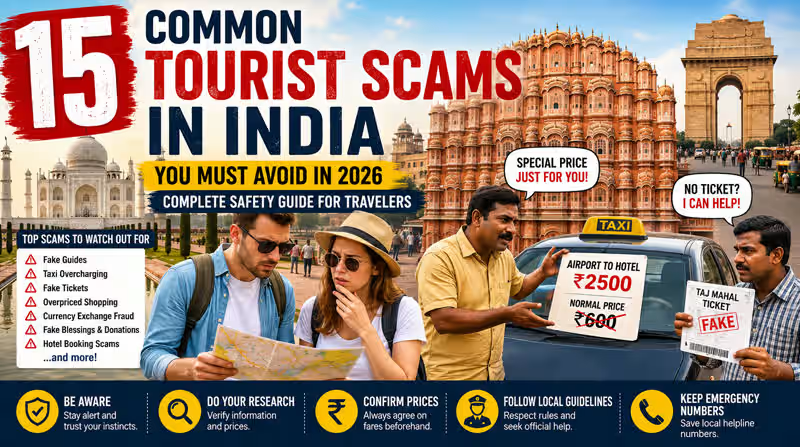
India is known to be a particularly hospitable country. Visitors are welcomed with open arms, and by and large, the general public will go out of their way to help tourists in all sorts of ways. But like they say, it takes an exception to prove the rule.
Especially in the big cities, where tourism is a booming business, there will always be the occasional unscrupulous tout or scammer waiting to take advantage of an unsuspecting traveller. Delhi, Agra, Varanasi, and Jaipur see the highest volume of international tourists in India — and with that comes a concentration of opportunistic scams that target visitors who are unfamiliar with the local landscape.
The best way to protect yourself is to be informed before you travel. Almost every common tourist scam in India follows a recognizable pattern — and once you know what to look for, they are easy to spot and avoid. To avoid falling victim to scams, it is best to be forearmed. Here are some of the most common tourist scams in India and exactly how to handle them.
India is a genuinely hospitable country. The vast majority of people you meet — from hotel staff and local guides to shopkeepers and fellow travelers — are warm, generous, and honest. The country’s reputation for incredible food, jaw-dropping history, and unforgettable experiences is entirely deserved, and millions of tourists visit every year and return home with nothing but positive memories.
That said, where there are tourists, there are also people who try to take advantage of them. This is not unique to India — it happens in popular destinations all over the world. But India’s scale, the language differences, and the sheer volume of tourists in certain cities and at certain landmarks mean that you are more likely to encounter opportunistic scammers here than in some other destinations.
The good news is that almost every common tourist scam in India follows a recognizable pattern. Once you know what to look for, they are surprisingly easy to identify and sidestep. This guide covers all the major scams you might encounter — what they look like, how they work, and most importantly, how to avoid them without ruining the spirit of your trip.
Awareness is everything. You do not need to be suspicious of everyone you meet. You just need to know the playbook.
This is one of the most elaborate and convincing scams in India, and it tends to be most common in North India — particularly around Delhi, Agra, and Jaipur. It has caught out even experienced travelers, so it is worth understanding in detail.
Here is how it typically unfolds. You arrive at a train station or tourist area and are approached by someone — sometimes in an official-looking uniform — who tells you that the tourism office has moved, or that there is a special registration required for foreign tourists. They may show you a laminated ID card that looks legitimate. You are taken to an office that looks convincingly official, with maps on the walls, staff behind desks, and printed brochures everywhere.
Once inside, you are told that your hotel booking is fake, that your tour operator is not government-registered, or that your train tickets are invalid. They offer to sort everything out for a fee — booking you into a “verified” hotel or arranging “genuine” transport. Everything about the setup is designed to create urgency and make you feel that paying is the only way to fix the problem.
It is all completely fabricated.
How to avoid it:
This one usually involves your taxi or auto-rickshaw driver. You have booked a hotel, given the driver the address, and are on your way. Somewhere along the route, the driver tells you that your hotel has closed down, is “fully booked,” has had a fire or flood, or is “not a good area.” He helpfully offers to take you to a much better option — usually one where he earns a commission for every guest he brings in.
Occasionally, the driver will actually take you to your hotel — but stop in front of a different building on the same street and claim it is the correct address. If you go inside, the staff will confirm that your hotel is “full” and offer you their rooms instead.
This scam is common in Delhi, Varanasi, Agra, and Jaipur, and it works because newly arrived travelers are tired, disoriented, and do not always have local mobile data to verify things on the spot.
How to avoid it:
Overcharging tourists on taxi and auto-rickshaw fares is one of the oldest and most universal scams in India. It happens in almost every city, but is most prevalent at airports, train stations, and around major tourist sites.
The driver will refuse to use the meter — claiming it is broken, that the route is a fixed-price trip, or simply quoting you an arbitrary number that can be three to five times the actual fare. Some drivers agree to use the meter but take the longest possible route to run up the cost. Others stop at shops along the way, telling you the shop is “on the route” but actually collecting commissions for bringing in tourist customers.
Newer travelers who do not know the correct fare for a given route are the most vulnerable to this.
How to avoid it:
This one tends to happen in restaurants and bars that cater primarily to tourists. You order a meal, drinks, and perhaps a dessert. When the bill arrives, it includes items you did not order — an extra round of drinks, a dish you never asked for, or a “cover charge” that was never mentioned.
If you point out the error, the staff will apologize and remove the incorrect items. But here is the catch: the taxes and service charges on the corrected bill are often still calculated on the original inflated total. If you do not specifically ask for a completely new bill from scratch, you end up paying more than you should.
Some establishments do this systematically with tourist customers, banking on the fact that most people do not check the math carefully.
How to avoid it:
This is a sleight-of-hand trick that happens during cash transactions — most often when you are paying for something or receiving change. The scammer palms one or more of the notes you have handed over, then claims you have not paid enough. Alternatively, they swap a genuine note for a counterfeit or a lower-denomination note while appearing to count your change.
It happens quickly, it is done confidently, and it relies on the fact that most tourists are not watching closely enough. Markets, auto-rickshaws, small roadside shops, and money exchange counters are the most common locations for this trick.
A variation of this involves giving you torn or very worn notes as change — notes that shopkeepers and vendors will often refuse to accept. You end up with currency that is technically valid but practically useless.
How to avoid it:
You are walking toward a monument, temple, or tourist site when someone in semi-official clothing stops you and asks for a “road fee,” “entry permit,” “photography tax,” or “tourist registration fee.” They may have a clipboard, a receipt book, and a uniform that looks vaguely official. The amount asked is usually small enough that most tourists just pay to avoid the hassle.
None of it is real. There is no such fee, no such permit, and no official authority behind the demand. The money goes directly into the scammer’s pocket.
This scam also appears in a vehicle-based form. On some roads leading to tourist areas, individuals set up unofficial “checkpoints” and demand money from passing vehicles, claiming it is a toll or a state entry fee. Drivers unfamiliar with the route may pay without questioning it.
How to avoid it:
This is one of the most financially damaging scams in India, and Jaipur — known as a city of gemstones and jewellery — is where it happens most frequently. It is also found in Delhi, Agra, and other major tourist hubs.
The setup usually begins with a friendly conversation — on the street, at a café, or sometimes through a driver who “happens to mention” that a relative runs a gem shop. You are taken to what appears to be a reputable jewellery or gemstone store. The staff are polite and professional. You are shown high-quality stones — rubies, sapphires, emeralds — and told that India has some of the cheapest gems in the world. So far, so believable.
Then comes the hook. You are told that because of Indian export regulations, you cannot take the gems out of the country yourself — but they can ship them to your home address. You pay a significant amount for stones you believe are valuable, give your address, and leave. The package either never arrives, or it contains worthless glass or low-grade stones worth a fraction of what you paid.
A variation involves being told you can resell the gems in your home country at a huge profit, acting as a kind of informal courier for the shop. This is not only a scam but could potentially involve you in customs violations.
How to avoid it:
At almost every major monument in India — the Taj Mahal, Red Fort, Amber Fort, Qutub Minar — you will find people offering to be your guide. Some of them are genuinely knowledgeable and provide a great experience. Many are not.
The fake guide scam works like this: someone approaches you claiming to be an official guide, sometimes showing a laminated card that looks legitimate. They start walking with you and sharing information. The commentary is often inaccurate, incomplete, or simply made up. At the end of the visit, they demand a fee far higher than anything discussed at the start — or they were never upfront about a fee at all. The conversation then becomes uncomfortable and occasionally aggressive.
In some cases, the “guide” is less interested in showing you the site and more focused on steering you toward specific shops, photography spots that cost extra, or tour upgrades.
How to avoid it:
This is not always a malicious scam — but it can cost you both time and money if you are not aware of it. Many drivers in India — particularly those hired informally or through small agencies — receive commissions from certain shops, showrooms, and restaurants for every tourist customer they bring in.
During your journey, the driver may suggest stopping at a particular carpet emporium, marble shop, spice center, or textile store. The reason given will sound practical — “this is the best place for souvenirs,” “it is government-certified,” or “we need to stop here for a few minutes.” Once inside, the sales pressure can be significant, and prices are almost always inflated to cover the commission being paid to your driver.
Some drivers earn as much from shop commissions as they do from their actual driving fee, which means the pressure to take you to these shops is real and persistent.
How to avoid it:
India is full of genuinely friendly, curious, and hospitable people who will talk to you for no reason other than genuine warmth. So this is a tricky one — because not every person who strikes up a conversation is running a scam. Most are not.
However, the overly friendly stranger scam is a real pattern worth knowing. It usually starts with someone approaching you at a tourist site or busy area, asking where you are from, offering to take your photo, or mentioning that they are also from your country (or that their brother lives there). The conversation is warm and natural. After a few minutes, they suggest going for tea, visiting a family shop, or attending a special festival or ceremony happening “just nearby.”
The destination — whether a shop, a home, or a ceremony — typically involves a sales pitch, an inflated meal bill, or a request for money for a “donation” or festival contribution. The entire conversation was the setup.
How to avoid it:
Withdrawing cash and exchanging currency are routine parts of traveling in India, but both come with risks if you are not
Yahan se continue — ATM section se lekar poore blog end tak:
careful. Here is what to watch out for.
ATM card skimming involves a device fitted over or inside an ATM card reader that copies your card details when you swipe or insert it. A small camera or a fake keypad overlay captures your PIN. This is not unique to India but does happen, particularly at standalone ATMs in tourist areas rather than bank-branch ATMs.
Fake helpers at ATMs are another version of this. Someone stands near the machine and offers to help you if your card does not seem to be working — then watches you enter your PIN or distracts you while an accomplice notes your details.
Unofficial currency exchange is a separate but related problem. Unlicensed money changers in tourist areas will often quote you a very attractive rate, then count your money incorrectly, use sleight of hand to shortchange you, or give you old demonetized notes that are no longer valid.
How to avoid it:
Near temples, ghats, and other religious sites across India — particularly in Varanasi, Pushkar, Mathura, and Haridwar — you will often encounter men dressed as sadhus or holy men. Many of them are genuine. Some are not.
The scam works like this: someone in saffron robes approaches you, smiles warmly, and offers to bless you or apply a tilak (a red dot) to your forehead. They may place flowers in your hands, chant a prayer, or tie a thread around your wrist. The gesture feels spiritual and generous. But the moment the blessing is complete, they demand a substantial sum of money as a “donation” — sometimes becoming aggressive or following you if you refuse or offer less than they expect.
Once a tilak has been applied or flowers placed in your hands, the social pressure to pay can feel very real. That is exactly what the scammer is counting on.
A related version involves someone offering to perform a special puja (prayer ceremony) for you or a deceased relative, telling you it must be done at a specific ghat and will bring great fortune. The final request for money is always far beyond anything discussed or implied at the start.
How to avoid it:
Beyond knowing the individual scams, there are some broader habits and mindsets that will keep you safe and confident throughout your India trip.
| Situation | What to Do |
|---|---|
| Arriving at a new city | Use pre-arranged airport or station pickup through your hotel or tour operator — avoid random taxi touts at arrivals. |
| Booking tours and guides | Always book in advance through verified operators. Avoid guides who approach you unsolicited at monuments. |
| Shopping for souvenirs | Shop independently at markets or stores recommended by your hotel. Avoid any shop your driver suggests. |
| Paying bills | Always check every line item on a restaurant or hotel bill. Request a new bill if corrections are needed. |
| Handling cash | Count notes carefully when paying and receiving change. Carry small denominations to make transactions simpler. |
| Something feels wrong | Stay calm. Cite a pre-paid booking, threaten to contact authorities, or simply walk away. Do not panic or hand over money under pressure. |
| Verifying information | Call your hotel, tour operator, or check Google Maps before believing any story about closed roads, cancelled tickets, or moved offices. |
One of the most effective things you can do to reduce your exposure to scams in India is to travel with a reputable private driver and tour operator. When your transport, accommodation, and sightseeing are all pre-arranged through a trustworthy agency, you are simply not in the situations where most scams operate. You are picked up from your hotel by a known driver, taken directly to your destination, and guided by a licensed professional. There is no space for random strangers to insert themselves into your day.
It also helps enormously to stay connected — a local SIM card with data means you can verify any claim on the spot using Google Maps, call your hotel directly, or check reviews and official websites without depending on information from strangers.
Finally, keep perspective. The overwhelming majority of the people you encounter in India are genuinely kind, helpful, and honest. Do not let awareness of scams tip into suspicion of everyone. The goal is simply to recognize the patterns so that when they do appear, you can sidestep them calmly and get back to enjoying one of the most extraordinary countries in the world.
The fake tourist office scam and inflated taxi fares are among the most frequently reported scams, particularly in Delhi, Agra, and Jaipur. Both are easy to avoid by using pre-arranged transport and contacting your operator directly if anyone questions your bookings.
Absolutely. Millions of tourists visit India every year without any serious problems. Scams are opportunistic and largely avoidable once you know what to look for. India is a deeply hospitable country, and the vast majority of interactions with locals are genuine and positive.
Use Uber or Ola for city travel — these apps fix the fare upfront and track your route. At airports and train stations, always use the government-authorized prepaid taxi counters inside the building. For intercity travel, book a private driver through a reputable tour operator in advance.
Stay calm. Do not hand over money under pressure. Cite a pre-paid booking, ask for official ID or receipts, and walk away from the situation. Call your hotel or tour operator immediately. If the situation feels threatening, move to a public area and contact local police on 100 or the national emergency number 112.
Delhi, Agra, Varanasi, and Jaipur see the highest concentration of tourist scams simply because they receive the most international visitors. That said, scams can occur anywhere tourists congregate. Awareness and pre-arranged travel arrangements are your best protection regardless of destination.
Yes — and it is one of the most financially costly scams for tourists. It is particularly common in Jaipur. The best rule is simple: never buy gemstones or jewellery from any shop you were taken to by a driver or stranger, and never agree to a shipping arrangement where goods leave your hands before you leave the country.
Booking a private driver through a reputable agency is one of the most effective ways to stay scam-free in India. Most tourist scams happen in moments of uncertainty — waiting alone at a station, negotiating with a stranger for a taxi, or following someone you just met to an unknown location. A private driver removes all of those situations from your trip.
Private Driver India Tour, founded in 2006 by Mr. Amit Singh, is dedicated to providing unforgettable travel experiences in North India, led by professional drivers with years of expertise serving global travelers.
More About Us© Private Driver India Tour 2024-26 | All rights reserved.