
This city moves at its own pace — ancient, unhurried and completely unlike anything you have encountered before. It does not ask for your attention. It simply has it, from the moment you arrive until the moment you leave.
Varanasi, also known as Kashi and Benares, is one of the oldest continuously inhabited cities in the world. Pilgrims have been coming here for over 3,000 years to bathe in the Ganga, pray at the Kashi Vishwanath Temple and seek liberation from the cycle of birth and death. This is the spiritual capital of India — a place where every ghat has a story, every lane has a temple and every evening ends with fire and chanting on the river.
With three days, you can walk through the old city without rushing. You can attend both the evening Ganga Aarti and the morning aarti at Assi Ghat. You can take a sunrise boat ride when the mist still sits on the river. You can explore Sarnath, visit Ramnagar Fort across the river and see the extraordinary Swarved Mahamandir Dham — one of the largest meditation temples in the world, completed just recently and already one of Varanasi’s most visited sites.
This is a complete 3-day Varanasi itinerary. be carefully and you will leave this city having truly experienced it.
Tour Highlights
Accommodation & Customisation
Our 3 Days Varanasi Tour package includes comfortable stays in carefully selected, well-rated 3-star hotels in Varanasi, ensuring a pleasant and relaxing experience after your daily sightseeing. All accommodations come with modern amenities and daily breakfast to make your journey hassle-free.
For travellers seeking enhanced comfort, we offer flexible upgrade options to 4-star and 5-star hotels, allowing you to customise your stay as per your preferences and budget. Whether you are planning a romantic getaway, family trip, or spiritual journey, we can tailor the entire experience to suit your needs.
Included 3-Star Hotel
Hotels are confirmed at the time of booking based on availability. In case of unavailability, an equivalent or higher-category hotel will always be provided.
Morning — Arrival and Kal Bhairav Temple
Arrive in Varanasi by train, flight or road and check in to your hotel.
Once you have settled in, the first stop is non-negotiable — Kal Bhairav Temple.
There is a tradition in Varanasi that every visitor must first seek the permission and blessings of Baba Kal Bhairav before beginning any pilgrimage here. He is the Kotwal of Kashi — the divine guardian of the entire city. The temple sits in a busy lane of the old city, and the main deity is a fierce manifestation of Lord Shiva. The experience here is unlike most temples you have visited. Active, intense and deeply rooted in living tradition — it sets the tone for everything that follows.
After Kal Bhairav, if time and energy allow, you can also visit Mritunjay Mahadev Temple nearby — a Shiva temple with a strong local following, though this is optional.
Mid-Morning — Kashi Vishwanath and Maa Annapurna
Make your way through the narrow galis of the old city to the Kashi Vishwanath Temple — the most sacred Shiva shrine in India.
This is one of the twelve Jyotirlinga temples — the most important Shiva temples in the country — and it has been a centre of Hindu worship for thousands of years. The current temple was built in 1780 by Maharani Ahilyabai Holkar. The iconic gold-plated shikhara was made possible by a donation from Maharaja Ranjit Singh in 1835. Inside, the atmosphere is unlike anywhere else — the continuous chanting, the smell of flowers and sacred milk being offered, the press of worshippers from every part of India. Give yourself time here.
Directly beside the Kashi Vishwanath Temple stands the Maa Annapurna Temple — dedicated to the goddess of food and nourishment. She is considered the divine mother who feeds the city of Kashi itself. Most pilgrims visit both temples together in a single walk through this part of the old city.
Spend time after the temple visits exploring the surrounding galis. The lanes here are some of the most atmospheric in all of India — tiny shrines tucked into walls, tea shops that have been open for generations, sadhus sitting in doorways and the smell of incense from a hundred different directions at once.
Afternoon — Rest
Return to your hotel for lunch. Rest properly.
The evening is the centrepiece of Day 1 and you want to arrive at it with good energy. The Ganga Aarti at Dashashwamedh Ghat starts at 6:30 PM in summer and 6:00 PM in winter. Your boat needs to be on the river by 5:00 to 5:15 PM at the latest to get a good viewing position.
Make sure your boat is arranged in advance through your hotel, your tour operator or a trusted boatman at the ghat.
Evening — Boat Ride and Ganga Aarti
Board your boat in the late afternoon as the light starts to soften.
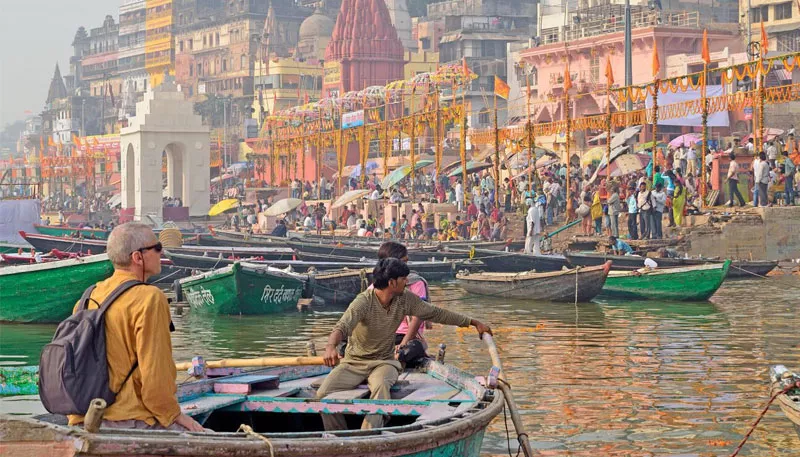
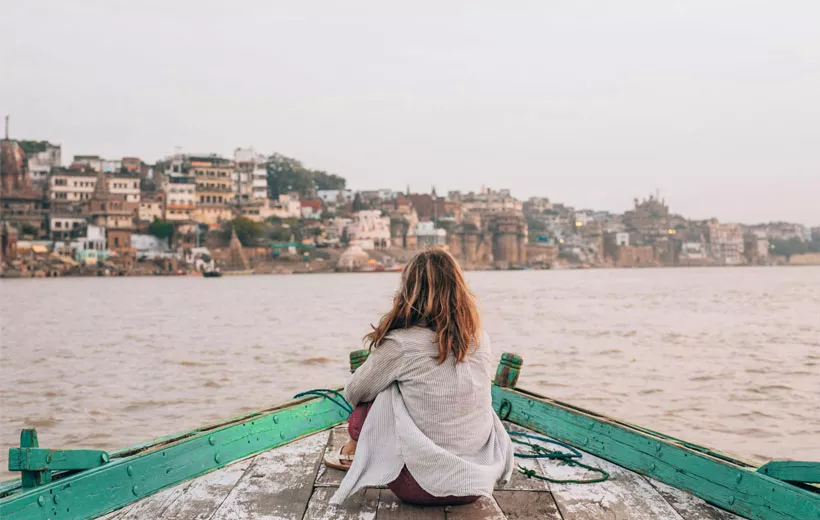
From the river, Varanasi looks completely different. The full sweep of the 84 ghats lines the western bank in an unbroken stretch of stone staircases, ancient temples, pavilions, and colour. You see the scale of the city from the water in a way that is impossible from the ghats themselves.
As your boat moves slowly along the river, you pass:
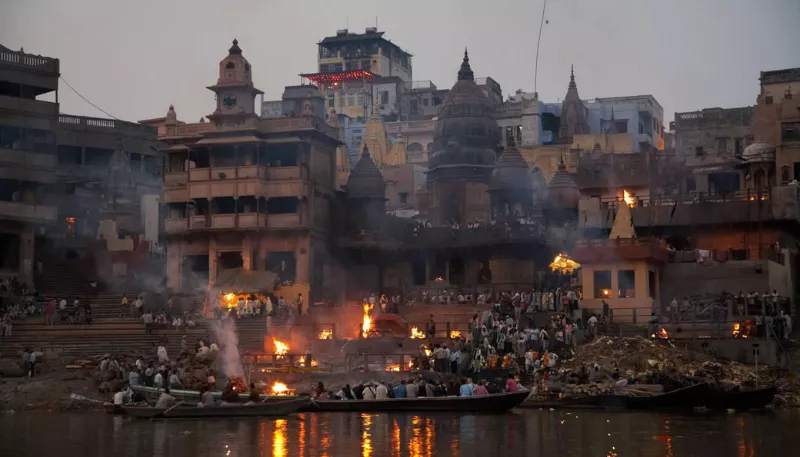
Manikarnika Ghat is a place of enormous spiritual significance. Hindus believe that dying in Varanasi and being cremated here grants moksha — liberation from the cycle of rebirth. The smoke from the pyres rises above the ghat around the clock. Watching from the river, with silence and respect, is an important part of understanding what this city truly is.
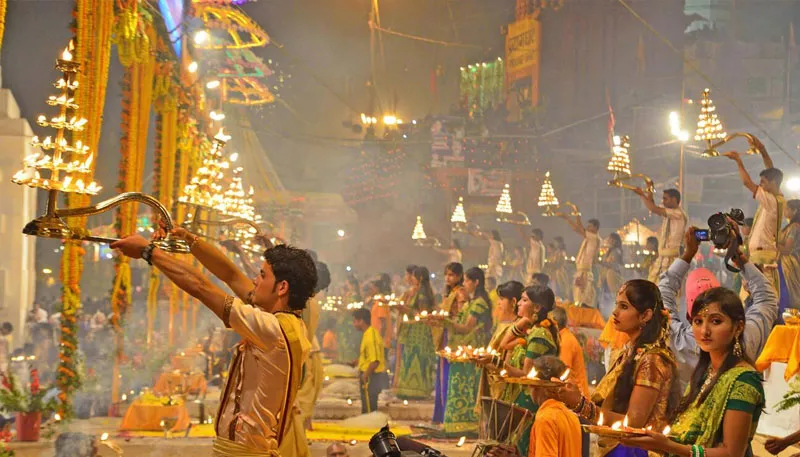
As darkness settles, the Ganga Aarti at Dashashwamedh Ghat begins.
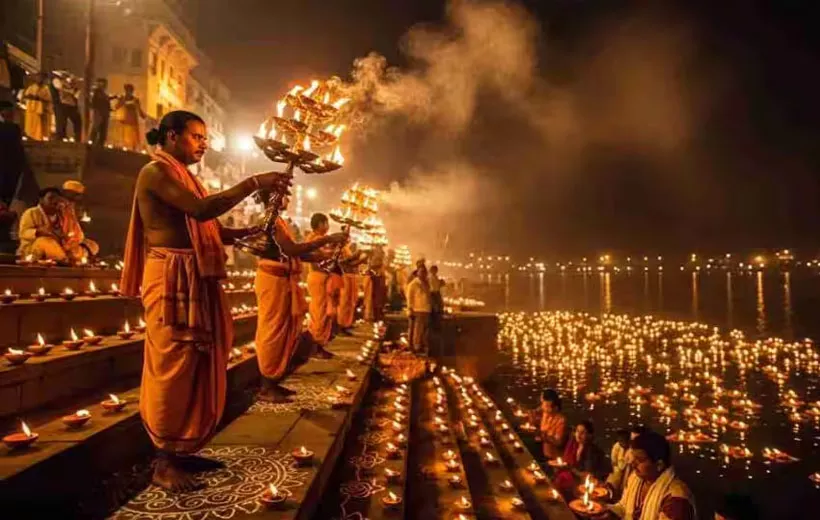
Seven priests perform a synchronized ritual with large multi-tiered brass lamps — raising them toward the sky, toward the river, sweeping them in slow circles — while Sanskrit mantras are chanted, bells ring continuously and thick incense smoke rises into the night air. Hundreds of earthen lamps float out onto the Ganga. The ceremony lasts around 45 minutes.
Watching it from the boat, with the lamp reflections shimmering on the water, is an experience you will carry with you for a long time.
After the aarti, walk through Vishwanath Gali — the famous lane for Banarasi silk sarees, silver jewelry and religious items. Have dinner at a good local restaurant. Try tamatar chaat, rabri jalebi or a proper Banarasi thali before sleeping.
Overnight in Varanasi.
Early Morning — Sunrise Aarti at Assi Ghat
Wake up early.
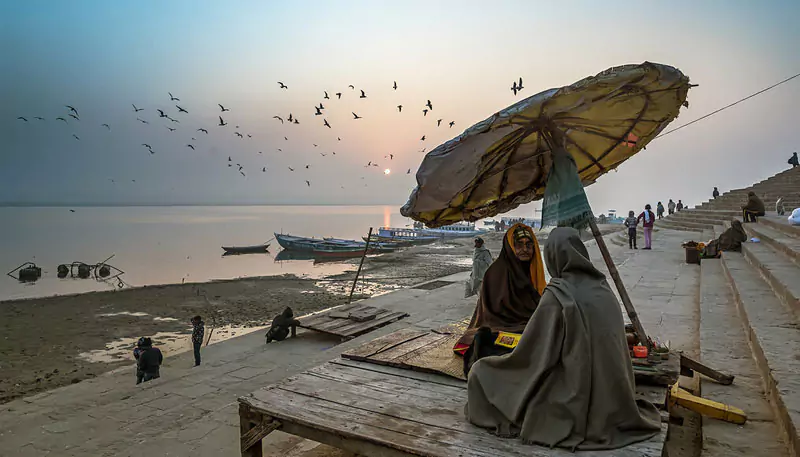
Be at Assi Ghat by 5:30 AM in winter or 6:00 AM in summer for the Subah-e-Banaras — the morning sunrise aarti. This is smaller and much more intimate than the evening aarti at Dashashwamedh. The mist sits low on the river. The light comes in slowly, turning from grey to gold. Boatmen row past in quiet rhythm. The chanting from the ghat carries across the water.
This is a side of Varanasi that many visitors miss because they sleep through it. It is worth every minute of the early start.
Morning — Boat Ride at Sunrise
After the sunrise aarti, stay on or return to the river for a morning boat ride.
The morning boat ride is especially popular in winter, when the mist over the Ganga is thick and the golden light comes through it in long shafts. Pilgrims bathe in the river at every ghat. Women perform rituals from the steps. Children play near the water. Flower offerings from the night’s aarti still float past. The city looks its most beautiful from the river in early morning light.
This is the photography moment of the trip.
Mid-Morning — Street Breakfast
After the boat ride, find a good street food stall near Godowlia or the lanes near Assi Ghat and eat a proper Banarasi breakfast.
The must-order combination is Kachori Sabzi — deep-fried spiced flatbread with a thick, spicy potato curry — followed by hot Jalebi dipped in sugar syrup. It is inexpensive, completely satisfying and deeply Banarasi. While you are at it, have a cup of hot chai from a kulhad (earthen cup) and order a Banarasi Paan to finish.
Late Morning — Temple Circuit at Durgakund and Sankatmochan
Drive or take an auto-rickshaw to the southern part of the city for the morning temple visits.
Durga Mata Mandir (Durgakund Temple)
This is one of the most striking temples in Varanasi — a red-painted structure built in the 18th century beside a large square tank called Durgakund. The temple is dedicated to Goddess Durga in her fierce form. Monkeys live throughout the complex and are considered sacred. Every morning the temple fills with devotees offering flowers, coconut and vermilion.
Tulsi Manas Mandir
Right beside the Durga temple stands the Tulsi Manas Mandir — a white marble temple built in 1964 at the very spot where the poet-saint Tulsidas wrote the Ramcharitmanas, the beloved Hindi version of the Ramayana. The walls of the temple are inscribed with verses from this sacred text. The atmosphere inside is calm and contemplative.
Sankatmochan Hanuman Temple
A short ride from Durgakund brings you to Sankatmochan Hanuman Temple — the most loved temple in Varanasi. Founded by Tulsidas himself, this temple is dedicated to Lord Hanuman and draws enormous crowds of devotees every day. The name means “the reliever of suffering.” Monkeys live freely within the compound. In the evenings, the temple hosts classical music performances attended by serious musicians and devotees from across India.
Afternoon — Banaras Hindu University and Banarasi Sarees
After lunch, visit the Banaras Hindu University (BHU) campus — one of the largest residential universities in Asia, spread across 1,300 acres in southern Varanasi.
Walk through the campus avenues lined with trees. The architecture is a mix of traditional and colonial styles. The main attraction for visitors is the New Kashi Vishwanath Temple (Birla Temple, VT BHU) — a beautiful white marble temple modelled on the original Kashi Vishwanath, funded by the Birla family and open to visitors of all faiths.
On the campus, the Bharat Kala Bhavan Museum is worth an hour of your time — it houses miniature paintings, terracotta figures, textiles, manuscripts and sculptures spanning thousands of years of Varanasi’s cultural history. Check opening times before you visit as it may be closed on public holidays.
After BHU, spend time browsing the Banarasi silk saree markets in the lanes of the old city or the textile shops near Godowlia. Varanasi produces some of the finest handwoven silk in the world and buying directly here is the best way to get authentic fabric at fair prices.
Evening — Ganga Aarti at Dashashwamedh Ghat (Again)
If you attended last night’s aarti from the boat, tonight watch it differently — from the steps of the ghat itself, standing in the crowd.
The experience on the ground is completely different from the one on the water. You are inside it rather than observing from a distance. The heat of the lamps, the press of people, the sound of the chanting and bells at close range — it is more overwhelming and more affecting.
If you prefer, attend from the boat again. Both perspectives are worth having over a 3-day visit.
Dinner at your hotel or a restaurant. Rest well. Day 3 is a full day outside the city.
Overnight in Varanasi.
Morning — Sarnath
Start Day 3 after breakfast with a drive to Sarnath — about 10 to 11 kilometres from the city centre, 20 to 30 minutes by road.
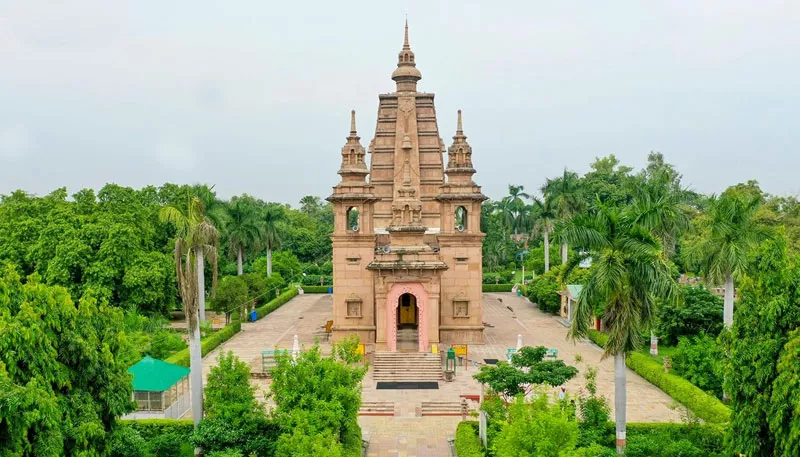
Sarnath is one of the four most sacred sites in Buddhism. This is where Siddhartha Gautama — the Buddha — came after attaining enlightenment at Bodh Gaya and delivered his first teaching to his five former disciples. That first sermon — the Dhammacakkappavattana Sutta — set the entire tradition of Buddhism in motion. Everything the Buddhist world is built on started in this quiet deer park beside the Ganga.
Key sites at Sarnath:
Dhamek Stupa
The most important monument in Sarnath. This massive cylindrical brick stupa stands 43 metres tall and marks the exact spot where the Buddha preached his first sermon. It was originally built by Emperor Ashoka in 249 BCE and enlarged to its current form around 500 CE. The carved stone band around its lower section is beautiful and very well preserved. Standing at the base of it — in the peaceful garden surrounding the site — is a genuinely moving experience regardless of your religious background.
Chaukhandi Stupa
Located near the entrance to the main site, this older stupa commemorates the spot where the Buddha reunited with his five disciples after attaining enlightenment. An octagonal Mughal-era tower was added to the top in the 16th century, creating an unusual combination of Buddhist and Mughal architecture in one structure.
Ashoka Pillar
The remains of the polished sandstone pillar erected by Emperor Ashoka in the 3rd century BCE. The famous lion capital that once sat on top of it — four lions seated back to back on a circular base — is now the national emblem of India. The original is housed in the museum here.
Sarnath Archaeological Museum
One of the finest small museums in India. The main attraction is the original Ashoka Lion Capital — seeing the actual object that became India’s national symbol, understanding where it came from and what it meant, is something that stays with you. The museum also holds exceptional Buddhist sculptures, inscriptions, terracotta figures and coins from different centuries.
Give Sarnath two to three hours in total.
Afternoon — Swarved Mahamandir Dham
After Sarnath, drive to the Swarved Mahamandir Dham — one of the most extraordinary spiritual buildings in India right now.
This is a massive seven-storey meditation temple built by the Sant Vihangam Mission, recently completed after decades of construction. It is designed to accommodate over 20,000 meditators simultaneously and covers an enormous footprint in the northern part of Varanasi. The building is covered in intricate stone carvings and white marble. Inside, the meditation halls are designed for complete silence and stillness.
It is not an ancient site — it is new — but the scale and ambition of it are genuinely impressive. The architectural detail is extraordinary and the spiritual atmosphere inside the meditation spaces is deeply calm. For anyone interested in Indian spirituality, architecture or simply in something unusual and powerful, this is one of the most interesting things to visit in Varanasi right now.
Late Afternoon — Ramnagar Fort
From Swarved Mahamandir, drive to the Ramnagar Fort — across the Ganga from the main city, approximately 14 kilometres from the Kashi Vishwanath Temple.
Ramnagar Fort was built in the 18th century by the Maharaja of Kashi, Balwant Singh, using cream-coloured chunar sandstone. It sits directly on the eastern bank of the Ganga and the view across the river to the Varanasi ghats from its walls is one of the best views in the city. The royal family of Varanasi still uses parts of the fort as their residence.
Inside the fort:
Give the fort and museum at least 1 to 1.5 hours.
Evening — Final Hours in Varanasi
Return to Varanasi for your last evening.
If energy allows, spend time at Assi Ghat — calm, local and without the crowds of Dashashwamedh. Sit on the steps and watch the river. Have a final chai. Buy last-minute gifts — Banarasi silk, rudraksha malas, brass figurines or handmade incense.
Have a final Varanasi dinner at a good restaurant. Try baati chokha — roasted wheat balls with spiced mashed potato and brinjal, one of the most traditional local dishes. Or go back to your favourite street food from the past three days.
Depart the following morning as per your travel schedule.
Overnight in Varanasi.
The tour usually includes 2 nights’ accommodation, daily breakfast, private AC vehicle, airport/railway transfers, guided sightseeing, and boat rides on the Ganges.
Key highlights include Kashi Vishwanath Temple, Ganga Aarti at Dashashwamedh Ghat, sunrise boat ride on the Ganges, Banaras Hindu University, Sarnath, and local market exploration.
Yes, witnessing the evening Ganga Aarti is one of the main highlights of the tour and is usually included on Day 1.
Most 3-day Varanasi tours are private, meaning the itinerary, vehicle, and guide are dedicated to your group for a personalized experience.
The ideal time is from October to March when the weather is pleasant for sightseeing and spiritual activities like boat rides and temple visits.
Generally, only breakfast is included. Lunch and dinner are usually excluded so travelers can explore local cuisine on their own.
Yes, modest clothing is required. Visitors should cover shoulders and knees while visiting temples and religious sites.
Yes, we require a 30% to 50% secure advance payment via UPI, bank transfer, or IMPS to confirm your booking, with the remaining balance payable at 25% payment on arrival and 25% payment before the end.
You can cancel free of charge up to 15 days before arrival. Cancellations made 7 days before arrival will incur a 50% charge, and cancellations within 48 hours of the tour start date are non-refundable.
We are here to help you with any inquiries regarding our services. Whether you need more details about our tour packages, want to book a trip, or have specific travel requirements, feel free to reach out to us.
Email: info@privatedriverindiatour.com
Phone: +91-9810368671
24/7 Our team is available to assist you. We look forward to helping you plan your perfect journey!
Private Driver India Tour, founded in 2006 by Mr. Amit Singh, is dedicated to providing unforgettable travel experiences in North India, led by professional drivers with years of expertise serving global travelers.
More About Us© Private Driver India Tour 2024-26 | All rights reserved.